If the medium is the message, messages created by LLMs are the lowest of them all.
Codebases
A few days ago, I submitted a one-line PR to a codebase that I’m using which was: completely broken, broke functionality that I didn’t care about, and completely incorrectly used operators that are part of javascript’s paradigm in place of Python’s (oops!) – but it worked for the very specific usecase I had. And I didn’t care, and still don’t care. Why? Because I didn’t (and still don’t) care about the codebase; and why should I? Nobody else does either – no body created it, it was generated by an AI. Spaghetti code that just “works” and people are happy with, versus a codebase that has the collective summation of emotions (love, hate, courage, enthusiasm, confusion, hopelessness, anxiety, guilty, trust, and irritation) that every contributor has felt when contributing. Instead, it’s just a pile of words on the screen, that nobody actually cares about – they just care about the result.
Evidently, not only do I not care about the codebase itself, I don’t care about the maintainer’s time to review those changes either: why should I?
Photography, crafts, sculpture, drawings, paintings, and everything else; these have always been art. Video games have always been art. Film, television, theatre, and all other types of media; they’ve all always been art. People investing time with their ideas, creating, where others just watch. High art, low art, it doesn’t matter. When you go to the art gallery and see a single stroke of a paint brush on in a frame, thinking to yourself, “this isn’t art! I could have made this!” the obvious response is “but you didn’t.” But it’s more than that: not only did you not make it, you also didn’t do it because you care enough to make it; or to care enough to come up with a story (real or not), or care enough that others see it. You don’t care.
What’s we’re losing with LLMs is art, which means we’re losing culture, and at the end of day, diminishing our enjoyment in the world: which is really the only point to life in the end. When we read code and look at the elegance of how it has been made, we enjoy it; not for its output, but for the inuitive solution which the developer has used to solve the problem. We appreciate the art of bit twiddling because it’s non-inuitive, difficult, and requires specialized knowledge. It requires that somebody not only really knew what they were doing, but really cared to do it in the first place.
Codebases written by LLMs are not art, and I don’t care about them. People who claim to care about them, don’t care about them: they care about the output. Nobody has the emotional attachment to the codebase, because they haven’t spent the mental capacity and exhausted their mental energy in building anything. Its worse than spaghetti code. At least with spaghetti code, somebody was actually trying.
And if nobody else cares, nobody else is trying, and nobody else is an artist, why should I waste my time pretending that I am?
So yeah. Oops. Wrong operators. Whatever. Give me a reason to value your time and codebase, otherwise it’s worthless to me; nothing special, nothing exceptional, and more importantly, nothing to learn from. If it was a private codebase, you would lose nothing if the source code got leaked, and the world wouldn’t learn anything.
 |
|---|
| The Thatcher Effect |
Articles
Those that need LLMs to write, are … artistically empty, and don’t appreciate the artform – and I’m sure don’t appreciate other artforms, either.
What makes reading enjoyable is that you’re reading something new. Something where you don’t know what the next word will be, what will happen next, and is inherently unpredictable; the whole point is that you are investing your time to understand something. The words have been chosen to convey somebody’s ideas; their thoughts, their reason, their being, their emotions, their imperfections, and their intentions.
“We are drawn not only to the intentional visuals of collaged surfaces, but also to the hidden expressions born of chance.”
Those expressions born of chance, of spontaneous thoughts stemming from difficulty or failure, simply don’t get made from predicting what people want to read or they expect to read. If you know what the audience is expecting to happen, and you just give them what they already expect, what’s the point?
Text generated by LLMs also remind me of autistic people. Like, actually autistic people. Depending on where they are on the spectrum, they may not understand social cues, don’t understand or include nuance, and are way too literal. They “learn” social patterns, because they simply can’t pick them up naturally. They follow rules which are “technically correct” (ish), but can’t “read the room” and misses the actual point. They feel like they’re talking at you, not to you. How annoying.
When it comes to language, I fall into the descriptionist rather than perscriptionist camp:
Some English linguists, particularly those living in decades and centuries past, are prescriptivists. These scholars believe that there is one right way to speak and write English.
Unlike the prescriptivists, descriptivists do not see forms of English as right or wrong, but rather as fluid, evolving ways of communicating meaning. Descriptivism is a far less judgmental and arbitrary way of understanding language. Rather than saying how English should be used, descriptivists study how English is used.
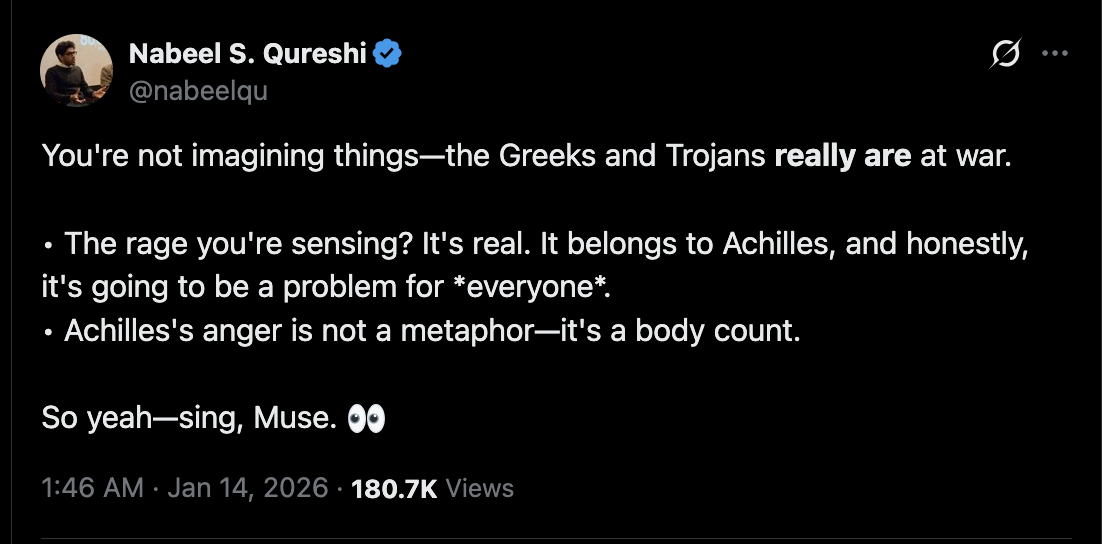
But wow, LLMs, when they write, sound completely soulless. And that’s because they are, and those that use texts generated by LLMs, don’t afford their souls to the texts, either.
 |
|---|
| Homer’s Iliad by an LLM |
 |
|---|
| @grok is this true? |
The LLM people
They just don’t get it, because they can’t appreciate that the journey is more enjoyable than the destination. Making is the point, not having.
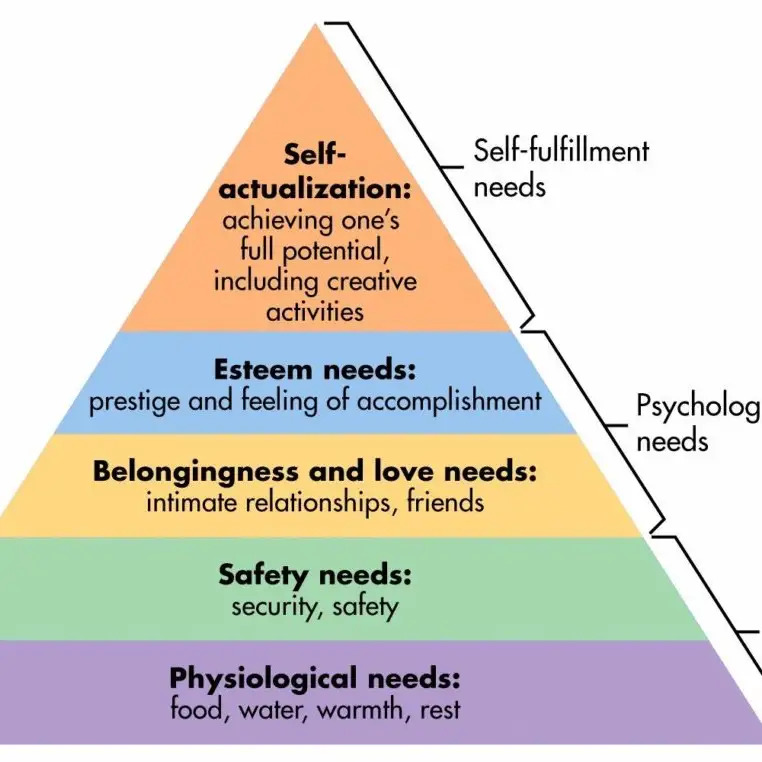
In the age of AI and LLMs at the click of a button, we completely eliminate peoples’ ability to realize what Maslow describes as the human need of “self-actualization” and “self-esteem”.
Doesn’t it sound fun, where you’ll have everything at the touch of a button, completely placid.
Try blue. It’s the new red.
 |
|---|
| Maslow’s Hierarchy of Needs |