This was originally written on April 16, 2020 and published on LinkedIn. I’ve decided to move the posts here for better searchability. Those that know me well, know that I am a video game history researcher, and this is just some of my random published articles.
Preface
Nintendo’s domination in North America is well documented with a plethora of books, magazines, wikis, and forums, all dedicated to information pertaining to the release of the Nintendo NES and the nearly one thousand games released for the console in the country. Likewise, Nintendo’s history in Japan has been extensively researched (albeit with limited English-oriented resources.) Outside of these two countries, however, there are very limited resources for both researchers and collectors to find history about Nintendo in their countries. The European (or otherwise) side of Nintendo’s operations are usually just a tidbit in publications, and less official publications extrapolate Nintendo’s American operations overseas; “Nintendo’s NES was a worldwide success” – something categorically incorrect. Of the specifically non-USA/Japan resources that do exist, they are usually very limited with very few well-researched topics, and ultimately exist purely for monetary purposes (e.g. ‘coffee table books’ which try to pass as research.) Due to this, there is so much information about Nintendo’s ventures into the European, Asian (outside Japan), Australian, and even Middle Eastern & African markets, that have been lost. Some of these markets were in fact pioneers for their time, and had ever-lasting effects on the gaming industries in their respective countries; something that has previously not been documented, especially in a formal manner.
Over the coming of months, I will be writing various articles about video games around the world, as well Nintendo’s official presences in countries that time and history has seemingly forgotten; Google does not contain this information. These articles are generally for people that are familiar with the Nintendo NES and have at least rudimentary knowledge of Nintendo’s operations during the NES period onward. Using the information that I’ve obtained over years of interviews, purchased collectible/historical pieces, and general research, I will be offering an insight into the gaming industry around the globe from ~1985-1995, and giving the recognition to the companies that helped shape video games in the “forgotten countries.”
The title of this series, “Video Games Around the World”, is the namesake of the 2015 book edited by Mark J. P. Wolf. But unlike Wolf’s book which is a compilation of essays by researchers all around the world, this series is more focused on specific and systematically researched topics. Apologies to the readers, but this series will be released non-chronologically; this fragmentation will be addressed near the end of this mini-series.
So, without further ado, let’s begin.
Nintendo in South Africa
As the NES craze had begun to die down from 1992 to 1994, it was anybody’s guess what Nintendo’s next move to globalization was. It had contracted with dozens of companies around the world to distribute its products, which at the time included the NES, SNES, and Gameboy. One market it had been unable to crack - mostly due to the lack of interest by Nintendo’s staff - was over 10,000 kilometers away from any official Nintendo distributor, and it was finally ready for Nintendo.
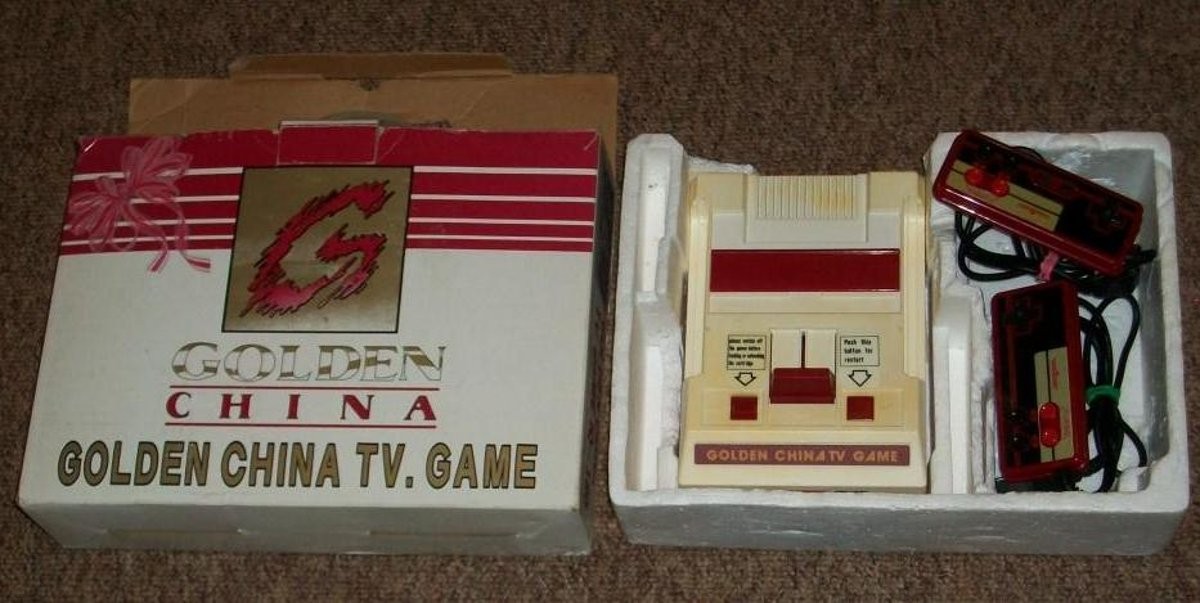
In 1992, South Africa was had already been exposed to the NES in various forms. Taiwanese clones and pirates were readily available. One such Famiclone titled the ‘Golden China’, was readily available throughout the major South African cities. “Reggie’s” (now Toys “R” Us), a chain of toy stores throughout the country, offered their own branded Famiclone, called the “Reggie’s Entertainment System” which was openly and freely sold throughout the country without repercussions. Imported authentic systems were low; those that did make it into the country were expensive, much more expensive than the average household was willing to spend on something they could get for cheap from a trusted, local, brand.
 |
|---|
| The Golden China TV Game Famiclone Common in South Africa. |
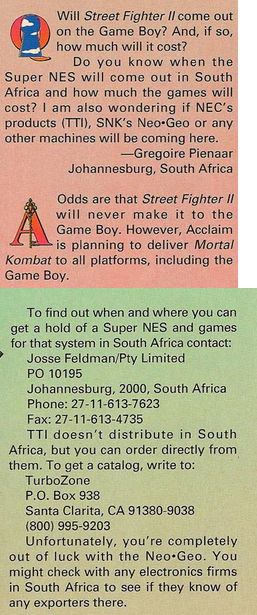
Josse Feldman (Pty) Ltd, headquartered in Johannesburg, had been in the toy distribution industry since 1982 and held the distribution rights for many big-brand names in the country, notably Mattel (including Barbie, Hot Wheels, etc.), Disney, The Simpsons, and Lego. Looking to expand their operations, they initially contacted Nintendo of Europe to sign the exclusive distribution rights for Nintendo’s products in South Africa. Up until 1992, Nintendo had seldom been interested in expanding its operations from the markets it had originally chosen to be part of the Nintendo-sphere. Despite the apprehension by Nintendo for supporting regions which could not meet traditional minimum order numbers, and given the recent consolidation of the segmented markets throughout Europe, Josse Feldman was given the distribution rights for the Nintendo Gameboy in late 1992. With no pirate competition in the handheld gaming market, the Gameboy was a great success in the country. Although Sega’s Gamegear was also officially available in the country, it faltered behind the Gameboy. Demonstration units were set up throughout the country, extravagant roadshows, and in-store displays also brought the authentic Nintendo experience to South Africa.
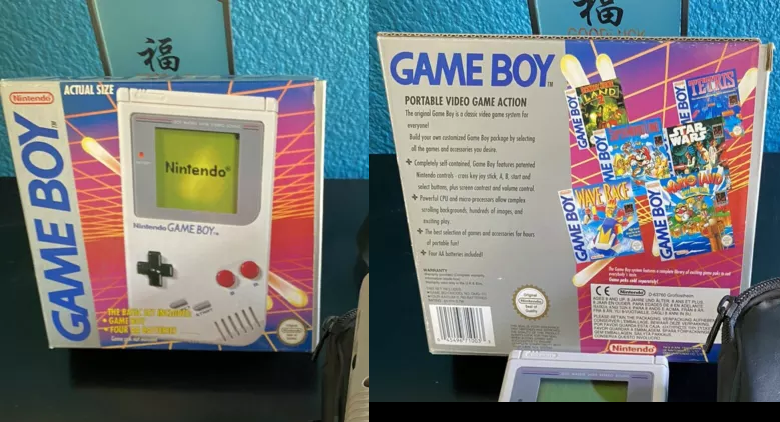
As South Africa was perceived as such a small market, Nintendo did not impose its normal restriction of a minimum tens of thousands of units. Instead of giving South Africa its own “region” and “region code”, Nintendo used its newly created -GPS region code, which was allocated distinctly for orders of small quantities around the PAL-format territories as well as ‘extra’ regions such as South Africa. Games were coded DMG-XX-GPS.
 |
|---|
| The South African Gameboy. “GPS” Coded, meaning it was released in various countries by low order amounts. |
Josse Feldman only ever sold the console and games; accessories such as carry-cases were imported by third-parties. Advertising was done on televisions, print media,and via in-store activities and “console stations” - pop-up demonstrative units in shopping malls in major cities. Games were only in English.
By 1993, with the success of the Gameboy’s launch in the country, Josse Feldman was gearing up for the release its next Nintendo product: the NES. Despite the NES’ technology being over 10 years old and the country having already been given access to the system through well-known Famiclones, the “South African Version” NES was ultimately released.
 |
|---|
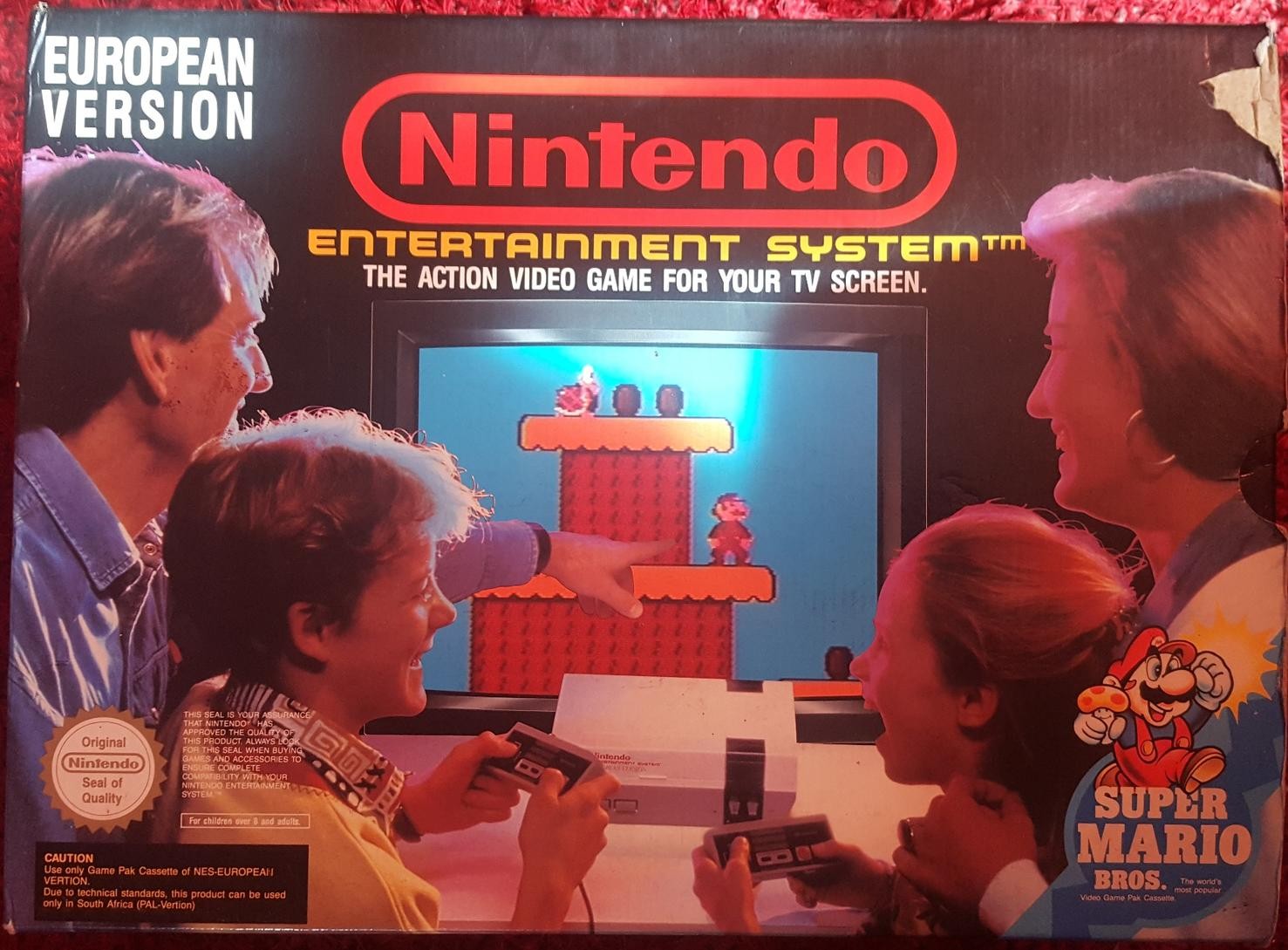
| Box of the South African Nintendo NES Console. |
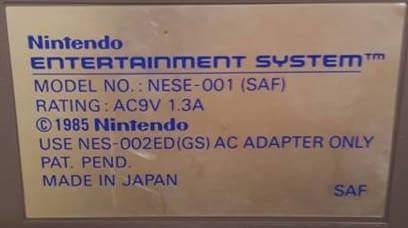
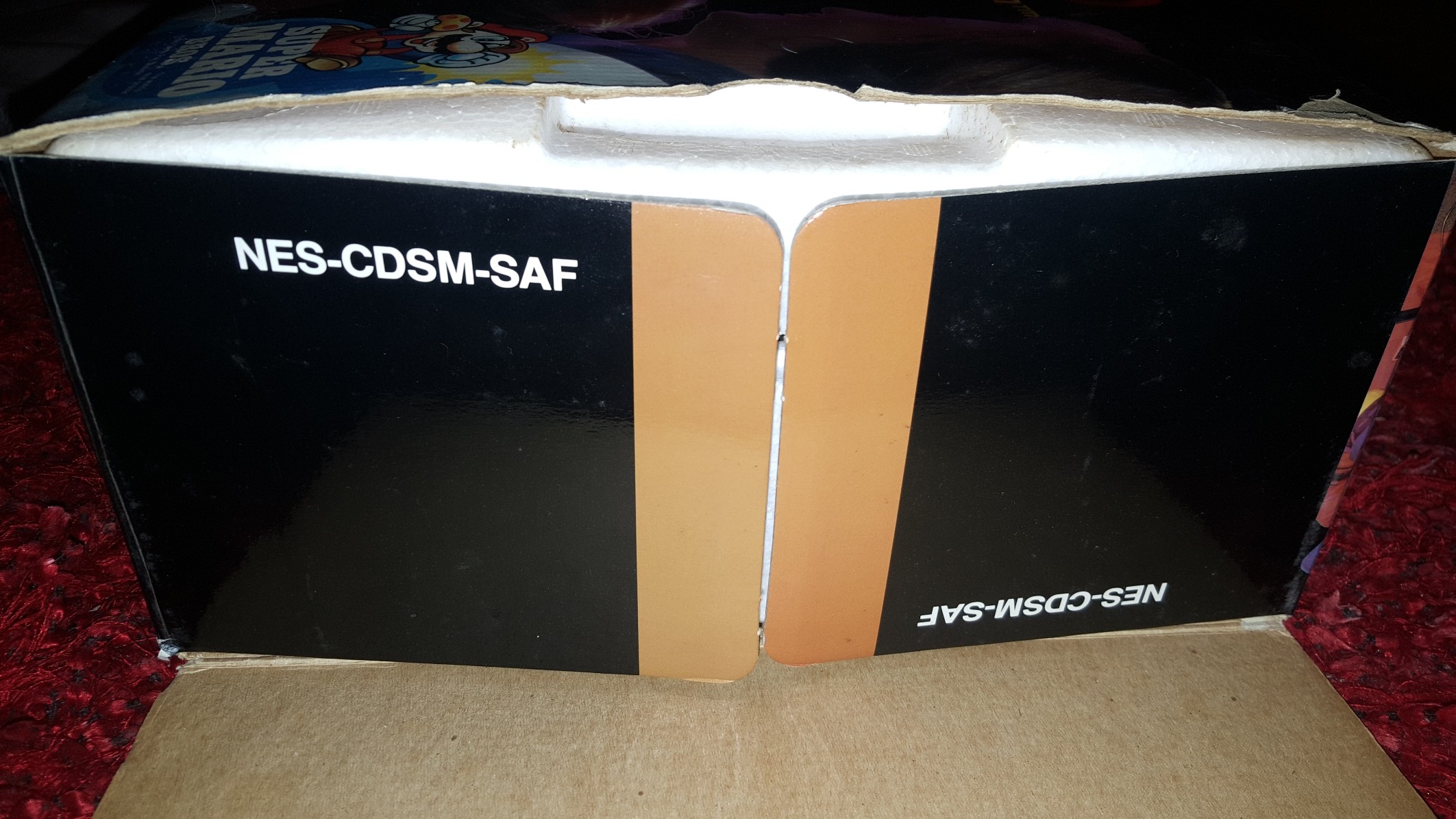
Unlike the Gameboy which had been released as a shared region console, the South African NES was released specifically as South African. Its box was an English variation of a German-specific box of the NES (which would also similarly be used as a shared region NES box, the NES-CDSM-GPO box, sold in very low quantities around the ‘European PAL’ region), and had written on the front “Use only Game Pak Cassette of NES-EUROPEAN VERTION[sic.]”, “Due to technical standards, this product can be used only in South Africa (PAL-Vertion[sic]).” The box of the console was coded “NES-CDSM-SAF.” It came with Super Mario Bros. included, which was marked as the “EUROPEAN VERSION,” and had the code “NES-SM-GPS.” The console itself was similar to the ‘normal’(if it’s possible to decide a ‘normal’ NES) European Version NES console, however its channel 3/4 switch had been removed from the back. On the bottom of the console, it had a sticker listing it as a “SAF” region product.
 |
|---|
| The underside of the South African Nintendo NES console. |
 |
 |
|---|---|
| Box of the South African Nintendo NES Console. | South African NES cartridge. |
What actually made it the ‘South African Version’, and why did Nintendo not just distribute the generalized -GPO console like they did in other smaller regions? Well, simply, because the power plug in South Africa is non-standard. Go figure!
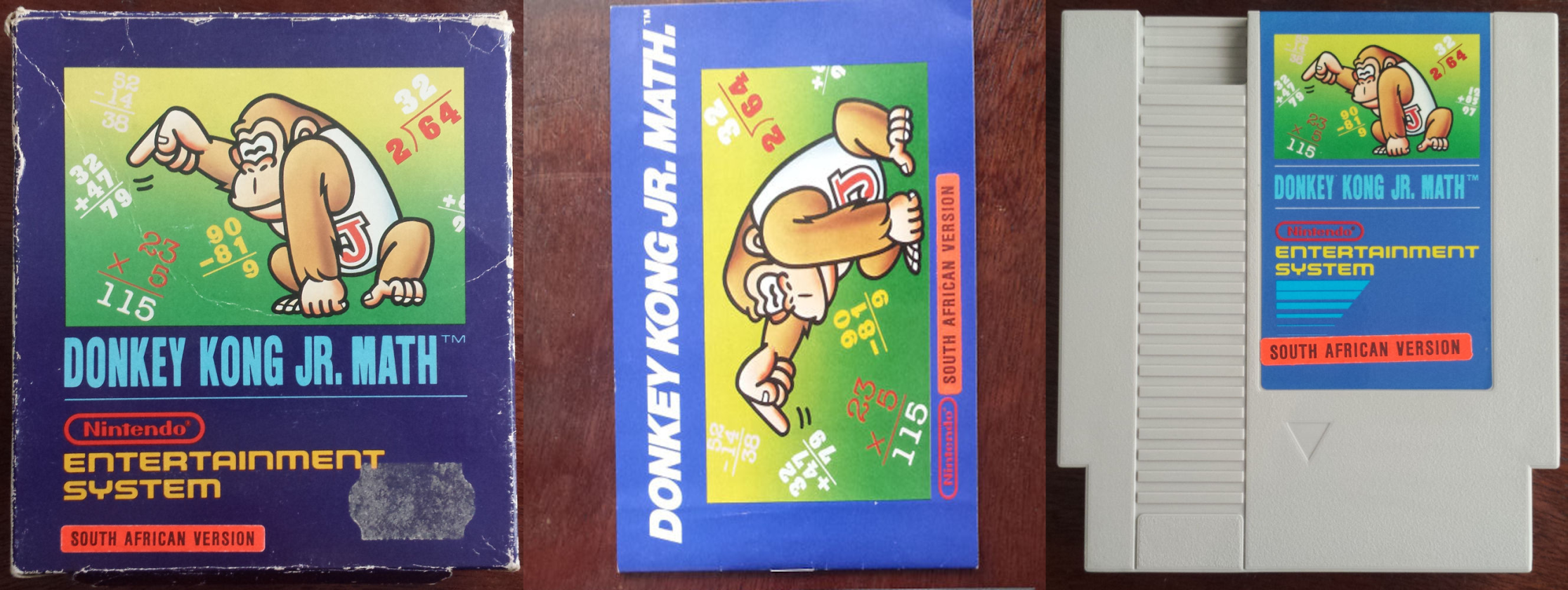
Despite the Super Mario Bros. game inside the console’s box being marked as the European Version, separate games sold in South Africa were completely different. On top of “European Version” (global -GPS games) games being sold in the standard rectangular NES game boxes, re-purposed Hong Kong NES games were sold as well. Due to the abundance of games that the Hong Kong region had left over from the attempts to sell the NES there, Nintendo was left with no choice but to re-purpose Hong Kong NES games for the South African market. Receiving “Hong Kong Version” NES games at its warehouses, workers of Josse Feldman had the gruesome task of unpacking the games and labeling the cartridges, manuals, and the boxes, with “South African Version” stickers, in place of the “Hong Kong Version” text. Interesting items for collectors these days, if they knew such items existed.
 |
|---|
| Game box manual and cartridge of a South African NES Game. |
Upon release, the console saw initial success, but it was obvious early on that there were pricing issues, and extreme market pressure from pirate consoles as well as pirate games, such as 1000-in-1 games. Since 1991, Nintendo had pursued various retailers and distributors of counterfeit products in the country, which ultimately led to a successful lawsuit which saw Nintendo collecting a substantial paycheck. Despite this and the order by the court for distribution to halt, due to the high cost of official NES products, piracy did not cease.
 |
|---|
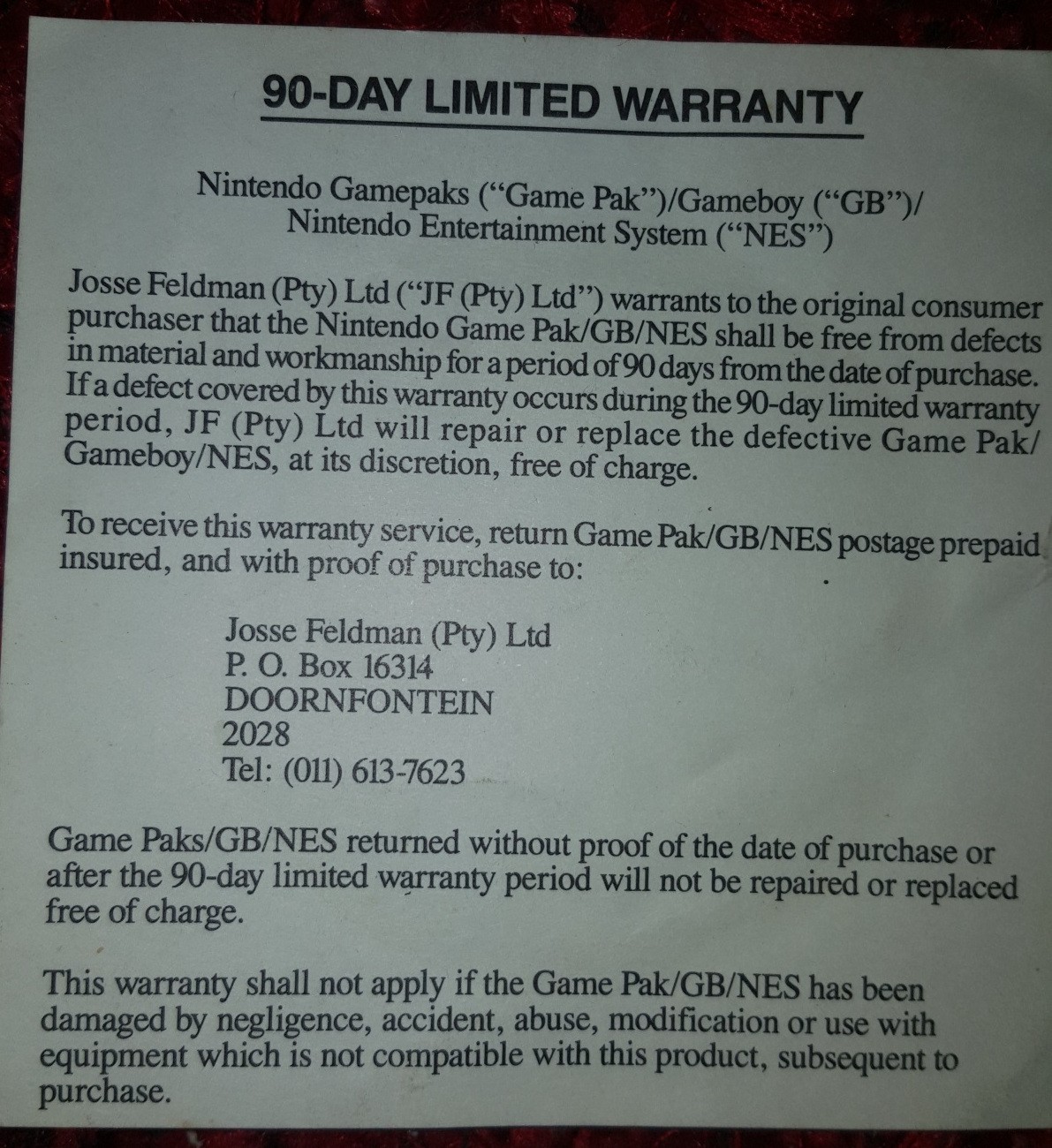
| Warranty Card For NES / Gameboy in South Africa. |
Josse Feldman held distribution rights for Nintendo up until 1995, when it finally ended its contract. It sold its remaining Nintendo stock and continued its other business ventures. In 1998, the company was purchased and renamed.
 |
|---|
| Only available reference from VG&CE magazine about Nintendo being in South Africa. |
Nintendo would not have another official distributor in South Africa until November 2002, when the company “Funtronic” began distributing the Gamecube and Gameboy Advance. The company also distributed the Nintendo DS, and lasted until January 2007 when it relinquished its distributorship rights. In September of 2007, the distributor “Core Group”, which is Nintendo’s current South African distributor, began control of the country, and released the Wii.
It is worthy to note that Nintendo’s UK distributor, THE Games Ltd (from August 1995), did hold the rights to distribute products in South Africa for some time, and had hoped to expand into other African countries as well. These products however were UK versions, and can be seen more as ‘exports/imports’ rather than truly South African
Perhaps it is not surprising that the internet does not have any reference to the official NES release in South Africa. News websites, forums, and other online resources all try to affirm that the NES was never released in the country. When the NES-mini was released, various South African tech-blogs boasted that it would be the first time that the NES would be officially released in the country. One person writing about an NES console that they had found stated “I have an NES that says ‘SAF’ on it. It would seem from previous owners comments to have come from south africa….but they never had a release of the Console?” This indoctrination that the NES was not released in South Africa was so powerful that even while holding physical evidence in their hands, the writer did not believe it could be real. Over at hardcoregaming101, which features an advertisement of the Reggie’s Famiclone, John Szczepaniak discusses the ‘gaming scene’ in 90s South Africa. He possibly got close to uncovering the official South African NES – “lot of stores selling grey-market models from Hong Kong” – too. Of course, I’m not trying to pass blame; history is lost and found. It is natural.
At the end of the day, I believe Josse Feldman and its staff, many of whom I interviewed to fully understand its operations, deserve recognition for being the first company to officially bring Nintendo to South Africa. What I have discussed is just the tip of the iceberg the country’s history; with this information revealed I hope that other collectors will be able to dig up more information about the country’s gaming history.
A huge thanks to UnforgivN / Rudy for the pictures of the SAF NES!